Psyllium Powder Manufacturer in India
Psyllium powder has become an important ingredient for nutraceutical brands, dietary supplement companies, and businesses developing fibre-based products. As consumers pay more attention to digestive wellness and dietary fibre, demand for reliable ingredient sourcing continues to create opportunities for manufacturers and suppliers.
India has an established psyllium processing and export industry. As a result, international buyers often consider Indian suppliers when sourcing psyllium powder for different commercial applications. However, choosing the right supplier requires more than comparing prices. Buyers should evaluate product specifications, quality checks, consistency, packaging options, and export capabilities.
Growequal Limited, based in Ahmedabad, Gujarat, provides third-party manufacturing and private-label solutions across nutraceutical, healthcare, cosmetic, and cleaning product categories. Businesses interested in fibre-based products can discuss their requirements with the company and confirm the relevant formulation and manufacturing capabilities.
In this guide, we explain what psyllium powder is, why India plays an important role in its supply chain, and how businesses can choose a suitable manufacturing or sourcing partner.
What Is Psyllium Powder?
Psyllium powder comes from the outer coating of the seeds of Plantago ovata, a plant commonly cultivated in India. Manufacturers process them into different grades and particle sizes according to the intended application.
The ingredient contains soluble dietary fibre. When mixed with water, it absorbs liquid and forms a gel-like substance. This property makes psyllium useful in several dietary supplements and food formulations.
Key Characteristics of Psyllium Powder
Businesses sourcing psyllium should understand its main characteristics before selecting a product specification.
- Natural source of dietary fibre: Psyllium provides soluble fibre for suitable nutritional formulations.
- Water absorption: The powder absorbs water and forms a gel-like consistency.
- Different grades: Suppliers may offer different particle sizes, purity specifications, and processing options.
- Versatile applications: Food, dietary supplement, and selected industrial formulation businesses may use psyllium according to their requirements.
- Bulk sourcing opportunities: Commercial buyers can explore suitable quantities based on supplier capabilities and product specifications.
However, not every grade suits every application. Therefore, buyers should share their intended use with the supplier before placing an order.
Why India Is a Leading Psyllium Powder Producer and Supplier
India plays a significant role in the global psyllium industry. The country has established cultivation, processing, trading, and export networks that support domestic and international demand.
Indian psyllium production is particularly associated with regions in Gujarat and Rajasthan. These agricultural areas contribute to the raw material supply chain, while processors prepare husk and powder grades for different buyers.
Established Agricultural Supply Chains
India has a long history of cultivating psyllium. This experience supports the movement of raw materials from agricultural areas to processing and trading businesses.
Consequently, international buyers can explore suppliers with experience in commercial sourcing and bulk ingredient requirements. Nevertheless, actual availability, grade, and pricing depend on harvest conditions, market demand, and supplier capacity.
Processing and Product Specifications
Psyllium processors may offer different grades according to particle size, purity, and other agreed specifications. Buyers should identify the required grade before comparing quotations.
For example, a business developing a fibre supplement may need a different specification from a company using psyllium in a specialised food formulation.
Export Experience and International Trade
Indian suppliers serve a range of international markets. Their export capabilities may include bulk packing, shipping coordination, product documentation, and communication with overseas buyers.
However, every shipment must meet the requirements of its destination market. Importers should confirm the relevant documentation, product standards, and customs requirements before finalising an order.
Benefits of Choosing a Psyllium Powder Manufacturer in India
Choosing an appropriate Indian supplier can help businesses manage ingredient sourcing and product development more effectively. The advantages depend on the supplier’s capabilities, the product grade, and the buyer’s commercial requirements.
Access to Established Sourcing Networks
Indian suppliers may have access to established agricultural and processing networks. This can help buyers explore suitable product grades and discuss supply requirements with experienced businesses.
Before committing to a supplier, ask about raw material sourcing, product specifications, and arrangements for maintaining consistency between batches.
Flexible Bulk Purchasing Options
Different businesses require different order quantities. For example, a growing supplement brand may need an initial commercial batch, while an established distributor may require larger volumes.
A suitable supplier should explain minimum order quantities, available packing sizes, lead times, and repeat-order arrangements. This information helps buyers plan inventory and manage purchasing costs.
Opportunities for Custom Product Development
Some businesses want to develop finished products rather than purchase only raw ingredients. Depending on the manufacturer’s capabilities, these projects may involve custom formulations, flavour options, sachet packaging, or private-label solutions.
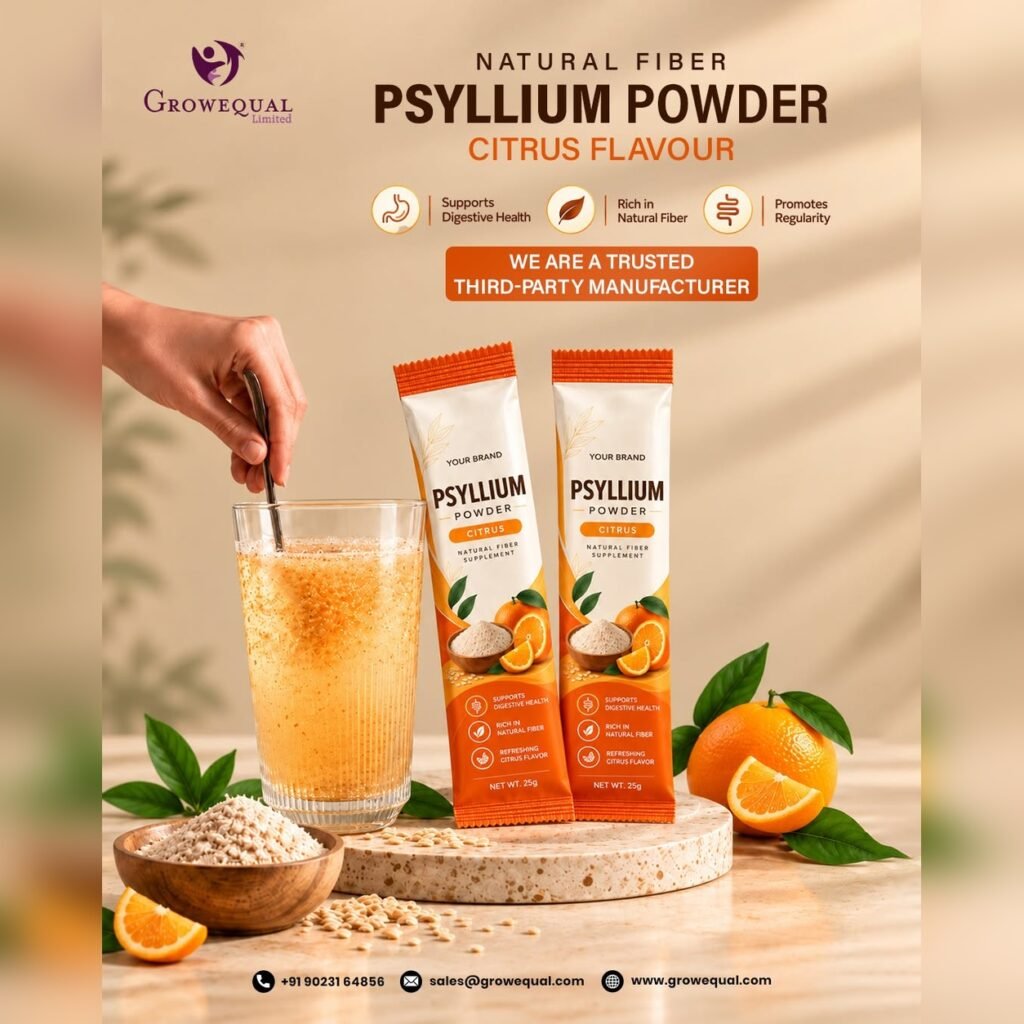
For instance, a brand may want to explore citrus-flavoured psyllium powder in single-serving sachets. The brand should confirm the formulation, ingredient compatibility, packaging requirements, and regulatory suitability with its manufacturing partner.
Support for International Buyers
Working with an experienced supplier can make communication and order planning easier. Buyers should review the supplier’s documentation process, product specifications, packaging options, and ability to coordinate shipments.
Ultimately, the right partner should provide clear information instead of relying only on broad quality or export claims.
Industries That Use Psyllium Powder
Psyllium has several commercial applications because of its fibre content and water-absorbing properties. However, suitability depends on the product grade, intended use, and applicable regulations.
Nutraceutical and Dietary Supplement Industry
Nutraceutical businesses use psyllium in selected fibre-based products. These may include powdered supplements, sachets, and other suitable dietary supplement formats.
A brand developing a supplement should define the serving size, ingredient specification, flavour, packaging, and applicable labelling requirements before production.
Food and Beverage Industry
Food manufacturers may use psyllium in certain formulations to support texture, water binding, or fibre content. Its use depends on the recipe, processing conditions, and local food regulations.
For example, selected bakery or specialty food formulations may benefit from psyllium’s water-binding properties. However, developers should test the ingredient in the intended recipe because it can significantly change texture and consistency.
Pharmaceutical and Healthcare-Related Applications
Psyllium Powder is also associated with certain fibre-based products used to support bowel regularity. Businesses exploring these applications must follow the relevant product classification, safety, quality, and regulatory requirements.
Manufacturers should not assume that a raw ingredient supplier can automatically produce a finished healthcare product. Buyers need to verify the partner’s specific licences and manufacturing capabilities.
Private-Label Wellness Brands
Entrepreneurs and established wellness companies may explore psyllium-based products under their own brand names. Depending on the production partner, options may include bulk powder, consumer-ready packaging, or custom product formats.
Before choosing a partner, buyers should confirm minimum order quantities, available formulations, packaging options, quality procedures, and delivery timelines.
How to Select the Best Psyllium Powder Manufacturer in India
Selecting the right supplier is an important step for businesses that need consistent ingredients and reliable commercial support. Use the following checklist to compare potential partners.
Check Product Specifications
First, request the product specification sheet. It should identify the product grade and relevant parameters for the intended application.
Depending on the product, useful details may include:
- Botanical identity and ingredient description
- Particle size or mesh specification
- Purity and relevant analytical parameters
- Moisture content and microbiological requirements
- Contaminant testing, where applicable
- Storage conditions and shelf-life information
Do not assume every supplier offers the same grade. Compare specifications against your actual product requirements.
Review Quality Control and Testing
A reliable supplier should explain how it manages product quality. Ask about incoming material checks, processing controls, batch traceability, and finished-product testing.
Where appropriate, request a Certificate of Analysis (CoA) for the relevant batch. Also, verify that the tests and limits match your intended use and destination-market requirements.
Certifications can support supplier evaluation, but buyers should check that each certificate is genuine, current, and relevant to the facility or product.
Evaluate Manufacturing and Supply Capacity
Your supplier should be able to explain its production or sourcing capacity and expected lead times. This matters particularly when your business plans repeat orders or seasonal campaigns.
Discuss these questions before proceeding:
- What is the minimum order quantity?
- Which product grades and pack sizes are available?
- Can the supplier support repeat orders?
- What lead time should buyers expect?
- How does the supplier handle product specifications and batch consistency?
Clear answers help reduce misunderstandings during procurement.
Compare Packaging and Private-Label Options
Packaging requirements vary by business model. Bulk buyers may need suitable ingredient packaging, while consumer brands may require retail-ready packs.
If you want a branded finished product, confirm whether the manufacturing partner can support your requested format. Options may include pouches, bottles, sachets, labels, and cartons, depending on the facility’s capabilities.
Additionally, review the packaging material, sealing method, storage conditions, and label information before approving production.
Assess Communication and Commercial Transparency
Price matters, but it should not be the only selection criterion. Compare quotations alongside product specifications, testing, packaging, minimum order quantity, payment terms, and delivery arrangements.
A dependable business partner should communicate clearly, answer technical questions, and provide written confirmation of agreed requirements.
Export Strength of Indian Psyllium Powder Manufacturers
India’s established psyllium supply chain creates opportunities for international buyers seeking ingredient sourcing and fibre-based product development. However, each destination market has its own import, safety, labelling, and documentation requirements.
Supplying Buyers in the USA
Businesses exporting psyllium products to the United States should confirm the requirements that apply to their specific product category. These may involve food or dietary supplement rules, facility obligations, ingredient compliance, labelling, and import documentation.
Importers should work with qualified regulatory advisers where necessary and verify that the supplier can provide the documents required for the shipment.
Serving the UK and European Markets
The UK and European markets also require careful product and documentation checks. Requirements can differ according to the destination, product classification, ingredients, and intended claims.
Before placing an order, buyers should confirm applicable food safety rules, ingredient status, labelling requirements, customs documentation, and any additional market-specific obligations.
Preparing for International Shipments
Export readiness involves more than finding a supplier with an attractive price. Buyers should confirm the following:
- Product specifications and agreed quality limits
- Batch-specific testing documentation, where required
- Suitable packaging and storage conditions
- Export and shipping documentation
- Destination-market compliance responsibilities
- Production timelines and shipment coordination
These checks help businesses prepare for international sourcing with clearer expectations.
Psyllium Powder Manufacturer in India for Growing Brands
Psyllium powder is a versatile source of soluble dietary fibre used in selected supplements, food, and other suitable formulations. India’s established agricultural and processing networks make the country an important source for buyers exploring domestic and international supply options.
However, choosing a supplier requires careful evaluation. Buyers should review product specifications, quality testing, batch consistency, packaging options, minimum order quantities, and export documentation before making a decision.
If you are searching for a Psyllium Powder Manufacturer in India, compare potential partners according to your product requirements rather than price alone. For private-label or third-party manufacturing projects, confirm the specific formulation, production capabilities, regulatory responsibilities, and commercial terms before proceeding.
Looking for a nutraceutical manufacturing partner? Contact Growequal Limited in Ahmedabad, Gujarat, to discuss your business requirements and explore suitable manufacturing solutions.
Frequently Asked Questions
Psyllium powder is a plant-derived ingredient obtained from the outer of Plantago ovata seeds. It contains soluble dietary fibre and absorbs water to form a gel-like consistency. It is used in selected dietary supplements, fibre products, and food formulations.
India has established psyllium cultivation, processing, and trading networks, particularly in Gujarat. These supply chains support domestic demand and international trade. Buyers should compare suppliers based on product specifications, quality documentation, and supply capacity.
Review botanical identity, particle size, purity, moisture content, microbiological limits, and relevant contaminant testing. Request a product specification sheet and a batch-specific Certificate of Analysis (CoA), where applicable. The parameters should match your intended product and market requirements.
Start by reviewing the manufacturer's product specifications, quality control procedures, testing documents, and manufacturing capabilities. Also, ask about minimum order quantities, packaging options, lead times, and batch consistency. Verify relevant certifications before finalising a supplier.
Nutraceutical companies, dietary supplement brands, food manufacturers, and selected healthcare product businesses may purchase psyllium powder. The required grade depends on the intended application. Buyers should confirm ingredient suitability and applicable regulations before production.
Pricing depends on product grade, purity specifications, particle size, order quantity, testing requirements, packaging, and prevailing raw material costs. Freight and export documentation may also affect the final cost. Request a detailed quotation based on your specific requirements.
No FAQ found.
Yes, many Indian suppliers offer bulk purchasing options for commercial buyers. Available quantities depend on supplier capacity, product grade, and current stock. Confirm the minimum order quantity, packaging format, delivery schedule, and repeat-order availability before placing an order.
Psyllium consists of the separated outer covering of Plantago ovata seeds, while psyllium powder is processed into a finer form. Particle size and processing can affect water absorption, texture, and handling. Buyers should select the appropriate form for their formulation.
Buyers can review the product specification sheet, relevant laboratory reports, batch-specific CoA, traceability information, and quality management procedures. Independent testing may be appropriate for additional verification. Certifications should be checked for validity and relevance to the supplier's facility.
Packaging may include sealed bags, lined bulk packs, or other suitable commercial formats, depending on the supplier. Packaging should protect the powder from moisture and contamination during storage and transportation. Confirm pack sizes, material specifications, and storage recommendations before ordering.
Yes, businesses can explore private-label opportunities through suitable manufacturing partners. Depending on the partner's capabilities, projects may include branded powder products, customised packaging, and selected formulation options. Confirm minimum quantities, label requirements, production capabilities, and regulatory responsibilities before starting.
Flavoured psyllium powder products may be possible through an appropriately equipped formulation partner. Flavour selection should account for taste, ingredient compatibility, texture, and the powder's water-absorbing properties. Final formulations should undergo suitable quality and stability assessments.
No FAQ found.